Selected learning experience 06
Grade 4 · Scientific observation & inference
How do corn snake adaptations help them survive in the wild?
A compact science inquiry co-taught with our district science director that moved from close observation and comparison to a habitat prediction grounded in evidence.
The context
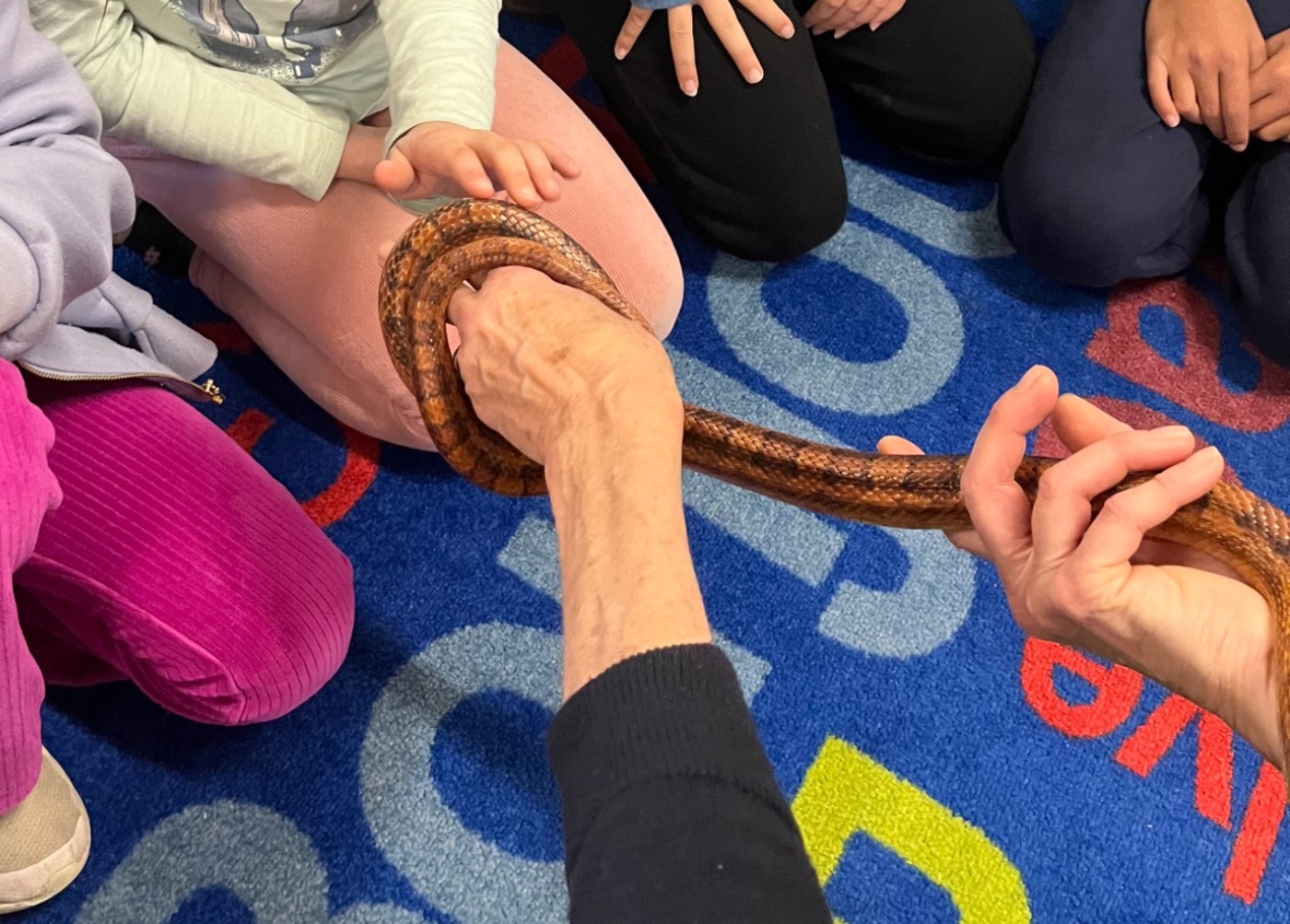
With Romeo, a corn snake, at the center of the lesson, students investigated how an animal’s body structure can offer clues about the way it survives. We began by comparing corn snakes with mealworms. Both animals are elongated, but students quickly discovered that a similar outline can conceal very different structures, movement patterns, senses, defenses, and needs. From there, we studied corn snake adaptations and reverse-engineered the question of habitat: if these traits help the animal hunt, hide, move, and regulate its body, what kind of biome would make those traits useful? Students used their growing knowledge to predict lightly wooded areas, grasslands, and fields before testing those ideas against what we learned about corn snake habitats.
The learning journey
From curiosity
to meaningful action.
- 01
Observed Romeo closely and generated questions about movement, coloration, body covering, senses, and behavior
- 02
Compared corn snakes and mealworms, noticing that two elongated animals can have fundamentally different body structures and adaptations
- 03
Connected specific corn snake traits to possible survival advantages, including camouflage, movement through narrow spaces, and finding prey
- 04
Used those adaptations as evidence to predict the environmental conditions in which corn snakes would be successful
- 05
Revised habitat predictions toward lightly wooded areas, grasslands, and fields, explaining how the environment and the animal’s adaptations fit together
Teacher reflection
“The strongest part of this lesson was its reverse-engineered reasoning. Students were not given a habitat fact to memorize; they built a claim from structure and function, then checked whether the evidence held together. Comparing Romeo with mealworms also disrupted the easy assumption that animals with similar shapes must be built for similar lives. A memorable animal encounter became a compact lesson in observation, comparison, adaptation, and scientific inference.”
Learning made visible through
Continue exploring