Students receive feedback from several sources, especially in writing and mathematics. They review their own work, consider another perspective, and decide how to act. These practices come together in different ways across assignments.
Start with self-assessment.
Students look at their work in relation to the learning goal or success criteria: What is working? What needs attention? What would help me move forward?
Peer feedback
Noticing and revising.
A classmate offers another perspective. Students practice giving specific feedback, considering it thoughtfully, and choosing a goal for their next attempt.
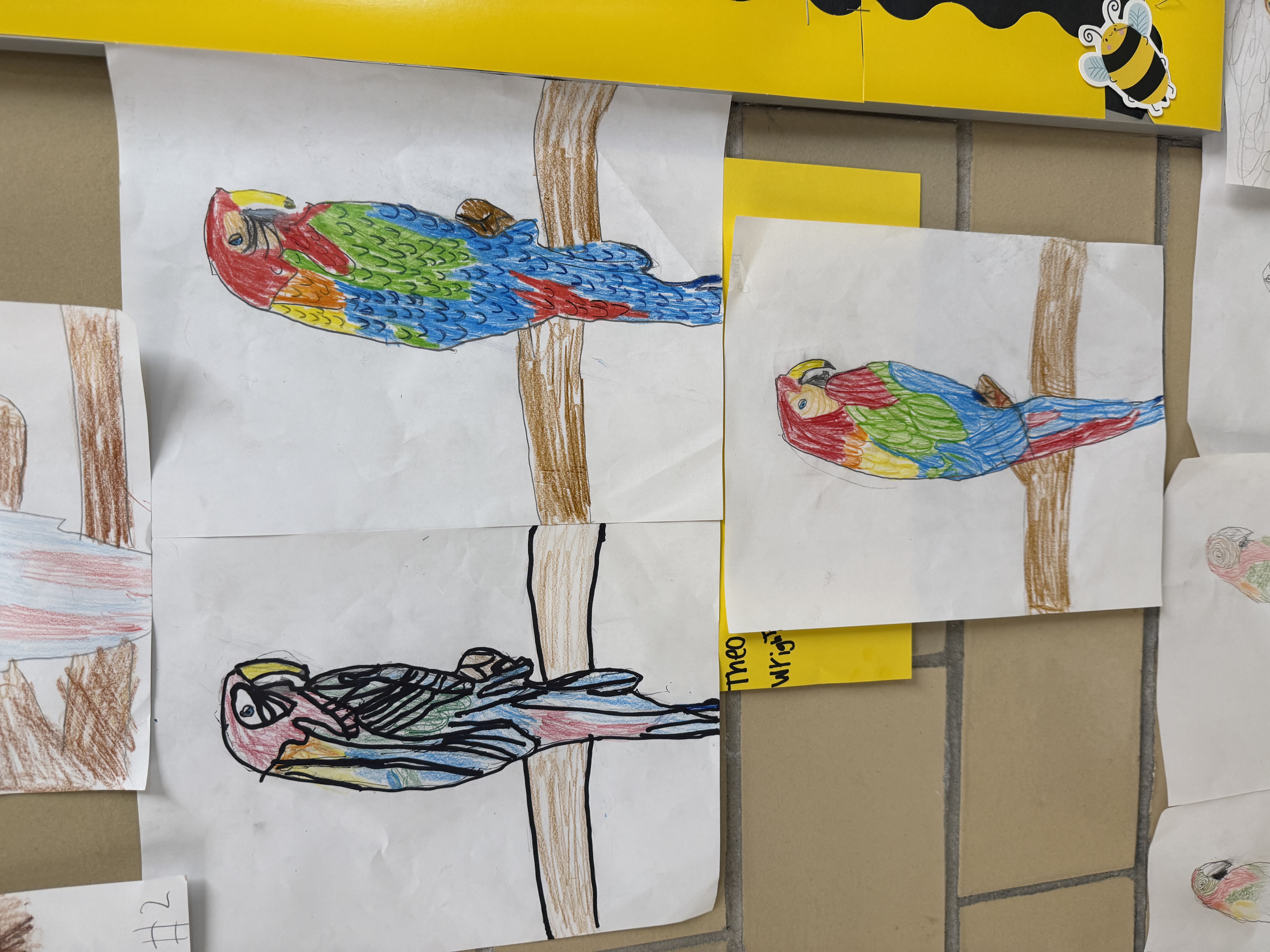
Three drafts. One purposeful change.
Students drew the same scarlet macaw three times, exchanging peer feedback and setting goals between drafts. For this student, feedback identified that a dark outline distracted from the strengths of his drawing. Before his final draft, he set a goal to use a lighter outline—and followed through.
01First draft
02Second draft
03Final draft
Students finished by comparing their drafts and reflecting on the choices that helped their work improve.
What peer feedback makes possible
Students learn to notice strengths, communicate useful observations, and take ownership of revision.
Teacher feedback
Dialogue and next steps.
I offer specific, actionable feedback and invite students to explain their thinking, ask questions, and try an approach. Their responses help shape the support and our next step.
From cubes to a mathematical connection.
When a student was struggling to distinguish factors from multiples, I sat beside him and posed a focused task: find the factor pairs of 12. I asked what tools could help. He preferred cubes, so we gathered them and explored ways to organize 12 into equal groups.
As we connected arrays, their dimensions, and factor pairs, he was surprised to discover that the dimensions were the factors. I then offered 15 as a chance to apply the idea. Without prompting, he collected three more cubes and built the different arrays.
The follow-up
I checked in with him and used another brief skill inventory to gauge how much of the concept he had retained. It was important to me to hear him explain his thinking verbally first, then give him the opportunity to show me with cubes.
He could explain much of the idea, but his demonstration with cubes was clearer than his verbal explanation. I interpreted this as a sign that his understanding was developing but was not yet secure, and that concrete models remained an important support.
We made a plan together: the next morning, he would explain and demonstrate the concept to a friend who had already mastered the skill. The purpose was to strengthen his own understanding through practice, with a knowledgeable listener. Organizing his thinking, demonstrating with cubes, and putting the connections into words would give him another opportunity to anchor and solidify his learning.
What teacher feedback makes possible
A conversation reveals the student's thinking, helps me tailor support, and builds a repertoire of strategies he can choose independently.
Feedback becomes useful when students act on it.
A revision, a new strategy, or another attempt gives students a chance to use what they noticed. Reflection and follow-up help us decide what to carry forward and what still needs support.